
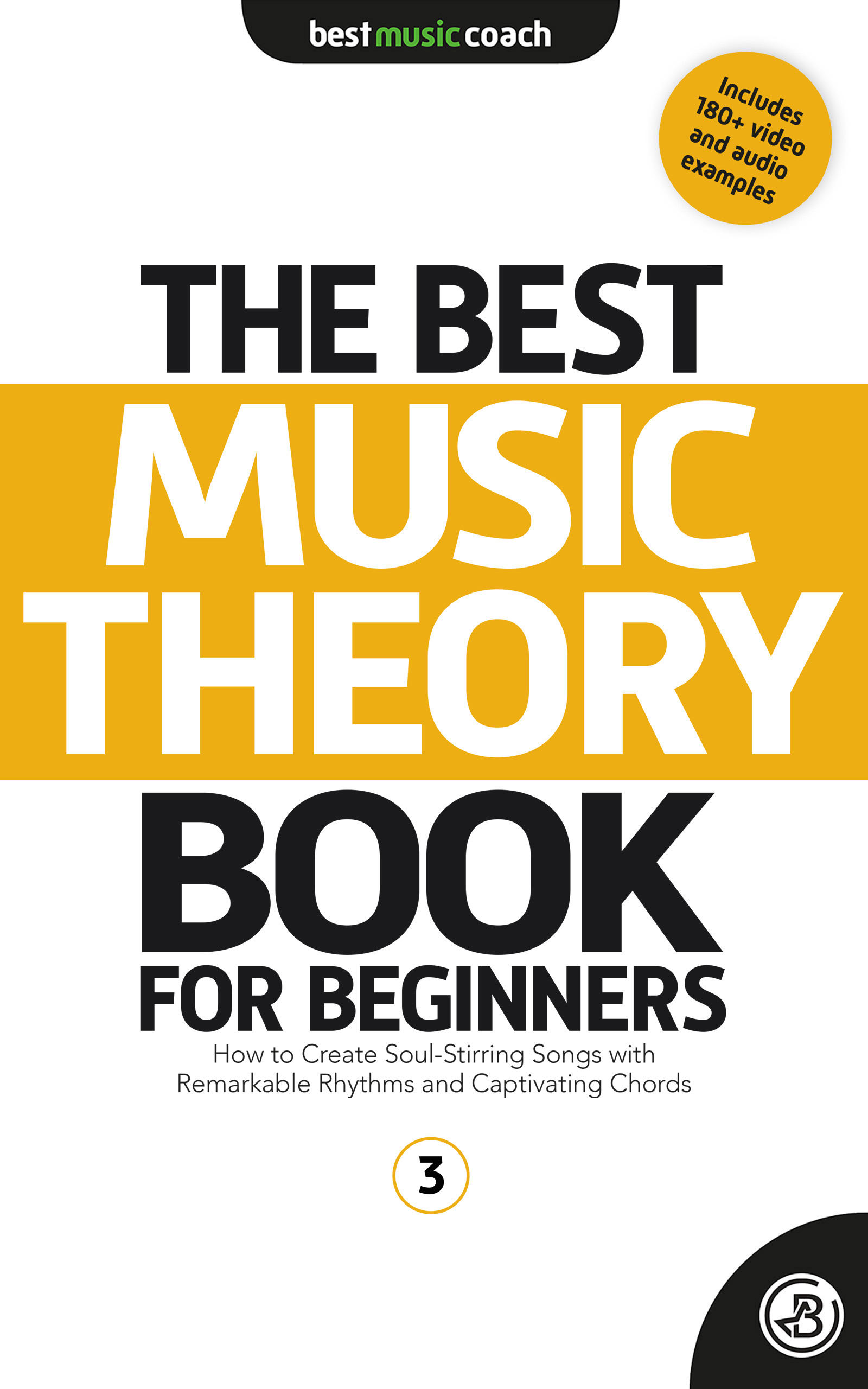
The Best Music Theory Book for Beginners 3
Use rhythm and chords to create music that feels alive.
A Level 3 music theory book focused on rhythm, chords, and the tools that help music feel more intentional and expressive.
What readers say after buying the book
These readers left five-star Amazon reviews. Each link opens the original review.
“It’s easy to understand and a good guide for beginners.”
DonaldMusic composition
Read on Amazon“This book fills in more gaps than I knew I had.”
Barry A. LehmanThis Book is Awesome!!
Read on Amazon“You will learn tips and tricks that will inspire you.”
Louise GlassMake music that captivates
Read on AmazonStart with the right book for your next step.
These are the main reasons this book can help you learn faster, practice with more focus, and keep moving.
Create stronger rhythms and chords
Use remarkable rhythms and captivating chords to make your music feel more intentional.
Explore borrowed chords and richer color
Explore complex harmonies and borrowed chords for more expressive writing.
Use theory to create feeling
Rhythm, chord choice, tension, keys, scales, and analysis become tools for music with stronger emotional direction.
What this book helps you do
Use this book to turn scattered music questions into a clear next step.
- Move beyond basic theory into more expressive rhythm and chord work.
- Understand how rhythmic choices shape the feel of music.
- Use chord ideas to support stronger songs and compositions.
- Continue the Best Music Theory path after Levels 1 and 2.
Who this book is for
- Students ready for Level 3 theory
- Composers who want rhythm and harmony to feel stronger
- Music makers who want theory to support real songs
If this sounds like where you are now, the book gives you a practical way to keep moving.
Use the book like a coach on the page.
This book is built to give you a clear next step, not just more information. Open the book, follow the sequence, use the examples, and keep moving.
Rhythm concepts for more expressive music
Chord tools for writing and understanding songs
Level 3 theory language
A continuation of the Best Music Theory Books for Beginners series
The book gives beginners a path, not just information.
Each part of the book is built around a practical learning sequence so the next step is easier to see.
Push past basics
Book 3 continues after the Level 1 and Level 2 foundation.
Shape rhythm
Syncopation and rhythmic choices change the feel of the music.
Color harmony
Borrowed chords and richer progressions add emotional contrast.
Analyze and apply
Students learn to recognize the tools and use them in their own music.
Access the examples for this book
Use the examples while you read so the book connects to sound, video, practice, and the next step on the page.
Create a free account to unlock the examples.
No purchase code is needed. Sign in once, come back to this section, and the examples for this book will open here.
Your examples are ready.
Open the lesson list below and use the examples that match the book as you work through it.
Open the examples for this book
Book materials
Open or download the support materials first, then continue into your examples below.
Course Content
Questions before you buy
What is Book 3 about?
Do I need the earlier books first?
Is it useful for video game music composers?
Where do I buy it?
How do I access the free examples?

Dan Spencer is Music Mentor Dan.
Dan Spencer is a composer, OST creator, author, and coach who teaches the practical path from idea, or no ideas, to finished music you can actually play, write, understand, and ship.