
Orchestration is the process of assigning musical parts to instruments and shaping how those instruments work together. It determines who plays the melody, how the harmony is presented, and how the parts support the music.
Music composition is the process of creating a piece of music by developing and organizing ideas such as melody, harmony, rhythm and overall structure.
You write a melody, put some chords underneath it, and bring in the strings. Then the woodwinds. Then the brass. By the time the percussion arrives, the opening is making a very convincing case for itself. You play it again. Sounds great.
There’s one small problem.
There isn’t a next section.
This is one of the mistakes I see people make when arranging music. All that attention goes into the opening, while the rest of the piece waits for its turn. It’s the musical version of skipping leg day. Impressive shoulders, enormous arms, and a pair of tiny legs left to carry the whole operation.
The way I work around this is to separate two questions: what is the music, and how are we going to present it? The melody and harmony answer the first. The arrangement and orchestration answer the second. What, then how.
This particular workflow is for thematic, melody-driven music. An ambient soundscape, where the whole point might be the texture of an open world, asks something different of you. Here, we have a melody. Let’s find out where it goes.
Give the melody somewhere to go
Think of the piece from left to right. Before I want a fully orchestrated opening, I want a melody that makes it from the beginning to the end. I want to hear it work without the chords behind it. Until it does, the melody still needs attention.
A piano sound is useful here, especially if you haven’t decided what instrument will play the melody. If you already hear or feel a particular instrument, use that instead. Either approach works. Keep the sound basic enough that you can hear what the melody is doing, and leave the detailed automation and key switches for later.
Working across the whole piece also gives the opening some company. You can hear what follows it and judge how the material fits together. That opening section may sound wonderful on its own, but eventually it has to take the listener somewhere.
If you’re still putting the larger composing process together, the video game music composition guide is a useful starting point.
The chords tell a story too
Now bring in the harmony. I prefer piano for this pass as well: piano for the melody, piano for the chords. You can use strings or another sound if that helps you work.
Ask: What melody note is happening? What chord do you want underneath it? What does that combination do to the story you’re trying to tell?
That’s the vertical view.
Then there is the horizontal one: the progression of those chords through time. A chord can work under a particular melody note, but you also have to hear where the harmony came from and where it’s going. The sequence has a story of its own.
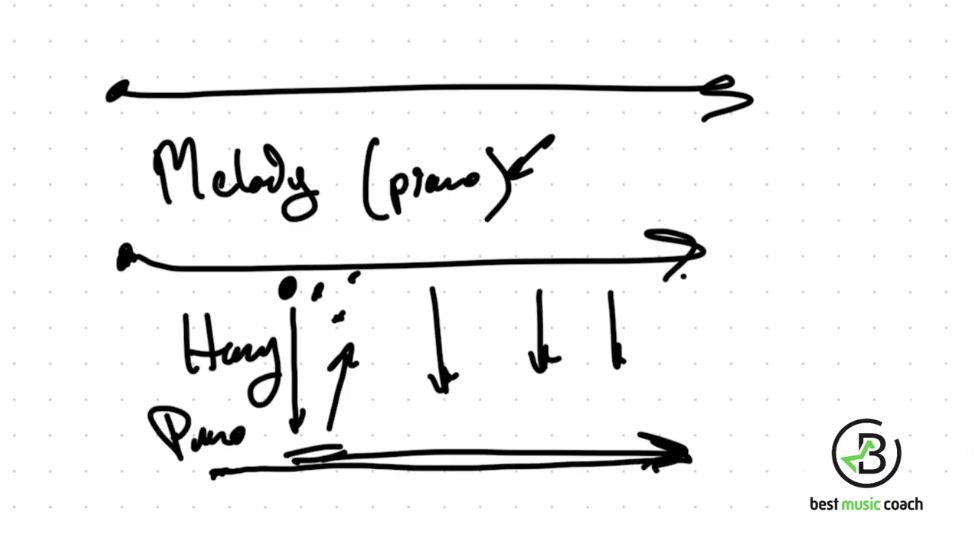
When I’m composing, I’m thinking in both directions together.
In the early days of learning to make music, it can help to separate them.
Work out the harmony beneath the melodic line, then go through the piece and listen to the movement of the chords. Give yourself room to hear both relationships.
Now you have a melody and harmony extending through the composition. This is the completed sketch. The music exists far enough along its own timeline that you can start deciding how the instruments will present it.
What are the strings doing here?
“Add strings” leaves a lot undecided.
You also don’t need strings at all. I’m just using this as an example. Your next question would be, “Okay what are the drums doing? What is the bass doing? What’s the guitar doing?” This method is genre agnostic…Anyway back to strings.
Do you want a full section? A few players? Do you want them carrying a melody, supporting the harmony, or punctuating particular moments? You might want separate lines working together. You might want chords. Those choices give the players different jobs, even though the track in your project still says “strings.”
Start with the role, then work through the piece with it. How will the strings present the harmony from left to right? What should they contribute as the music develops?
Do the same with any woodwinds or brass you choose to include. Every family is optional. Having space for another instrument in the project doesn’t, by itself, tell you what that instrument should do.
Percussion gets its own version of the question: how will it enhance what the other instruments are doing? Listen to the parts around it and decide what role it should play.
By the end of this pass, you have a full sketch. The instruments have parts across the piece, and those parts have a purpose. You can hear the arrangement as a whole before getting absorbed in the details of any one performance.
Let the parts become performances
Now go back through the layers and get more particular: articulations, dynamics, automation, and the key switches that help you access the articulations you want.
Start with the melody, then work through the instrumental layers you’ve included. You’re still moving horizontally through each part, but your ears also have to travel vertically. What else is happening at this moment? How does this instrument fit with the others?
Some of the writing may change as you listen. You might adjust what an instrument plays or how it presents the harmony to balance the arrangement. The complete sketch gives those decisions context. You can hear the part you’re refining alongside the music it needs to serve.
The little things need somewhere to happen
Finally, the ear candy. A transition. A small piccolo trill. One of those brief moments that catches your ear and makes you want to hear it again.
This pass brings your attention to particular places in the music. What’s happening in this section? What does this transition need? What would you like to happen right here, in this measure?
A little detail can make a considerable difference, but it needs a place in the piece. By now, you can hear that place. The melody goes somewhere. The harmony tells its story. The instruments carry their parts through the arrangement, with expression and balance considered along the way.
Press play from the beginning. Let the opening do its thing. When it reaches the next section, there is music waiting for it.
Watch the original lesson, or explore more lessons in Orchestration Odyssey.
Frequently asked questions
What is the difference between composition and orchestration?
Composition develops the musical ideas. Orchestration decides which instruments play them and how those parts work together. I think of it as what, then how: establish the melody and harmony, then work out how to present them.
Where should a beginner start?
For thematic, melody-driven music, I start with a melody that works from beginning to end. Keep the sound simple, then add harmony across the whole piece. Give yourself a complete sketch before polishing the opening.
Do I need strings or a full orchestra?
No. Strings are one example. You can ask the same questions about drums, bass or guitar: what is this instrument doing, and how does it support the music? Choose the instruments you want and give each part a purpose.
When should I work on articulations, dynamics and automation?
I make that pass after the melody, harmony and instrumental parts are sketched across the piece. Then I refine each layer’s articulations, dynamics, automation and key switches while listening to how it fits with everything else.
Gamer Music Creator Guild Results
- Guild members who have released music
- 25
- Total Guild member releases
- 114
- Average days to first release
- 67.2
- Guild soundtracks in progress
- 4
The average covers members who have reached a first release. See the releases and stories.